Career Pivot: The 90-Day Plan: From Confused to Interviews
If you’re itching for a career pivot but don’t want to “start over,” this is for you. I’ve pivoted from dentistry → strategy consulting → venture capital, and I now coach professionals across India to do the same—with clarity, a plan, and proof of value. Below is the exact 90-day system I use with clients to go from “I think I want to switch” to “I’m interviewing” (and yes, without six new certifications).
- Career Pivot: The 90-Day Plan: From Confused to Interviews
- What you’ll get from this career pivot guide
- Before we start: who this career pivot plan is for
- The 90-Day career pivot plan at a glance
- Phase 1 (Weeks 1-2): Clarity Sprint for your career pivot
- Phase 2 (Weeks 3-4): Positioning & Proof Plan for your career pivot
- Phase 3 (Weeks 5-8): Build Proof & Publish for your career pivot
- Phase 4 (Weeks 9-10): Applications, Referrals, LinkedIn Outreach & Interviews in your career pivot
- Phase 5 (Weeks 11-12): Accelerate & Close your career pivot
- Your weekly operating system (career pivot version)
- Common mistakes in India (career pivot pitfalls) and how to avoid them
- Resources you can steal for your career pivot
- What to do next:
- FAQ (career pivot)
What you’ll get from this career pivot guide
- A role shortlist that matches your goals, strengths, and constraints
- A positioning statement and a clear career pivot story (short + slightly longer)
- A keyword-smart, 1-page résumé and a magnetic LinkedIn profile
- 1-2 micro-projects (plus optional short courses or a micro-internship) that create proof of fit
- A simple outreach & application cadence that generates interviews
- A tracking system so you know what’s working (and double down)
Before we start: who this career pivot plan is for
- Mid-career professionals in India moving into Product, Strategy, Growth, Ops, Analytics, VC/PE, etc.
- Clinicians or domain experts moving to business/tech roles.
- Anyone who wants a repeatable process, not random job-board scrolling.
The 90-Day career pivot plan at a glance
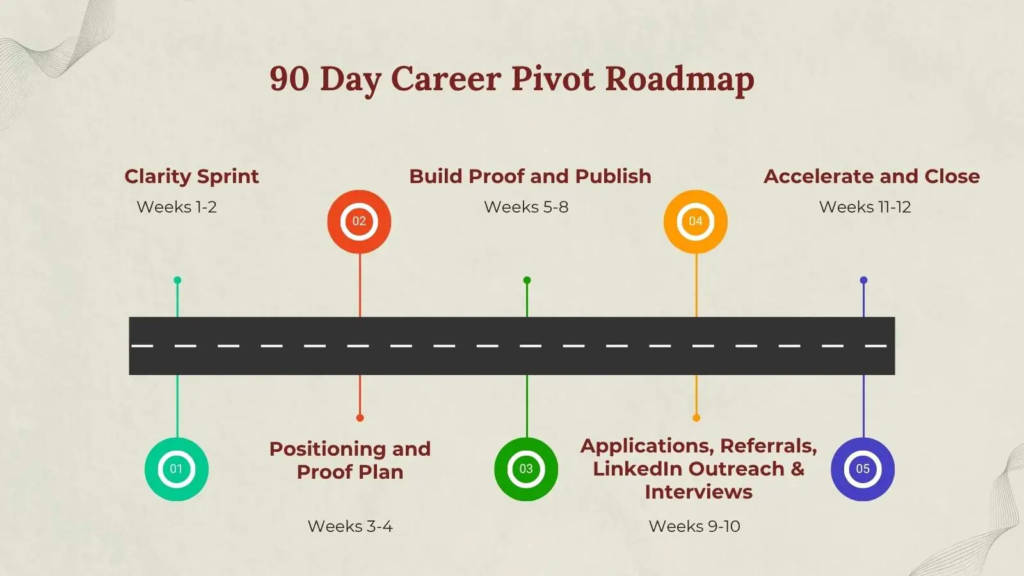
- Phase 1 (Weeks 1–2): Clarity Sprint (+ Informational Interviews)
- Phase 2 (Weeks 3–4): Positioning & Proof Plan (incl. your pivot story)
- Phase 3 (Weeks 5–8): Build Proof & Publish (projects + optional courses/internships + industry reading)
- Phase 4 (Weeks 9–10): Applications, Referrals, LinkedIn Outreach & Interviews
- Phase 5 (Weeks 11–12): Accelerate & Close
Rule of thumb: aim for 5-7 focused hours/week. Small, consistent steps beat weekend marathons.
Phase 1 (Weeks 1-2): Clarity Sprint for your career pivot
Goal: pick a believable destination and define your angle.
1) Role & Industry Shortlist
- Targets: max 2 roles, 2-3 industries (e.g., Product Manager in healthtech/fintech; Strategy in SaaS/D2C).
- Constraints: city/remote, salary band, timeline.
- Scorecard: rate roles on excitement, transferability, pay, growth.
2) Transferable Skills Map
List 6-8 strengths (e.g., stakeholder management, analytics, GTM, clinical insight). For each target role, map how each strength solves a typical problem.
3) Informational Interviews (the fastest clarity booster)
Don’t guess – talk to 6-10 people already in those roles/industries. Aim for 15-20 minutes on phone/Zoom/over coffee. Prep smart questions and keep it respectful.
For etiquette and question ideas, read “The right way to do informational interviews” (HBR).
- Who to reach out to: alumni, ex-colleagues, 2nd degree LinkedIn connections, people who post about the role, hiring managers in target teams.
- How to find them: LinkedIn (filter by title/company/location), alumni groups, mutual connections, Meetup/Slack communities.
- How to ask (short & respectful): “Hi [Name], I’m exploring [role/industry] and loved your post on [topic]. Could I borrow 15–20 mins for an informational chat? I’ll come prepared with specific questions – completely non-salesy. Thanks! – [Your Name]”
- Go in prepared: What problems do you solve weekly? What skills matter most? What does a “good” candidate look like? Tools/metrics? What micro-project would prove fit?
- Leave a good impression: be brief, ask targeted questions, don’t pitch; send a thank-you summarizing 1–2 insights + the project you’ll do.
- Referrals later, not now: do your project, then circle back with an update and a specific ask if appropriate.
Phase 2 (Weeks 3-4): Positioning & Proof Plan for your career pivot
4) Build your pivot story (short + slightly longer)

You need a tight narrative that makes your transition make sense-ready to deliver in 1–2 minutes (short) and 3-4 minutes (slightly longer). Structure: Past → Spark → Transferable skills → Proof → Ask. For an expert primer, read “Crafting a compelling career narrative” (HBR).
Example (short): “I’m a dentist turned consultant who led market access projects for pharma. I fell in love with building patient-centric products, so I’ve been doing product teardowns and a PRD for a health-tech idea. I bring clinical insight + data-driven problem-solving, and I’m targeting PM roles in health-tech, happy to share my projects.”
5) Résumé (1 page) & LinkedIn refresh
- Résumé bullets: Outcome (metric) → lever you pulled → context. “Cut onboarding time 32% by redesigning intake flow; partnered with eng to ship v2 in 6 weeks.”
- Keyword map: pull 10-15 recurring terms from target JDs (iimjobs/Naukri/LinkedIn) and sprinkle naturally.
- LinkedIn: Headline (role | industry | edge), About (short story + 3 proof points + CTA), outcomes-led Experience, and Featured projects. Boost recruitability with “Improve your visibility to recruiters on LinkedIn” (LinkedIn Help).
6) Choose your Proof-of-Fit Plan (pick 1–2 core items)
- Product: teardown (onboarding/pricing), PRD, metrics plan
- Strategy/Growth: market sizing, growth loop, cohort analysis
- Analytics: SQL/Excel case + dashboard & insights
- VC/PE: 2-page memo + light model
Anchor to outcomes: choose a North Star Metric and a small funnel to measure your project. This primer helps: “The North Star Metric (Amplitude guide)”.
Phase 3 (Weeks 5-8): Build Proof & Publish for your career pivot
Goal: show you can do the job before you have the job.
Weekly cadence
- Mon–Tue: work on micro-project (3-4 hours).
- Wed: publish a slice on LinkedIn (thread/post with visuals).
- Thu–Fri: 10-15 targeted outreaches + 4-6 smart applications.
LinkedIn post ideas (India-relevant)
- “What I’d fix in [app]’s onboarding (3 screenshots)”
- “[Company]’s growth loop in India-what’s actually working”
- “Size of [niche] in India-quick TAM and go-to-market angles”
Portfolio tip: keep one Index page (Notion) that links to each project, your résumé, and press/references-easy to DM.
Phase 4 (Weeks 9-10): Applications, Referrals, LinkedIn Outreach & Interviews in your career pivot
Goal: convert your proof into conversations.
Applications (smart > spray)
- Aim for 4-6 high-fit applications/week (LinkedIn Jobs, iimjobs/Naukri, company pages).
- Tailor the top third of your résumé to the JD.
Referrals & informational chats for jobs
Use your projects to start relevance, then ask for advice/a quick chat. Many chats naturally become referrals.
Scripts you can adapt
Connection request: “Hi [Name], I’m transitioning from [background] to [target role] and wrote [project/teardown] on [relevant topic]. Could I steal 15–20 mins to ask a few role-specific questions? I’ll keep it tight. Thanks!”
Follow-up ask (post-chat): “Thanks again-super helpful. I tightened [project/resume] based on your tips. If [role link] is relevant, would you be open to a referral? Happy to send a 3-line blurb.”
Interview prep (fast loop)
- Stories bank: 6 STAR stories (impact, conflict, stakeholder mgmt, failure, data, leadership).
- Case drills: 3 role-specific mini-cases/week (PM: priors/estimation; Strategy: market sizing; Analytics: product metrics).
- Company prep: 1-pager: product, metrics, competitors, “why now,” your 90-day plan.
Phase 5 (Weeks 11-12): Accelerate & Close your career pivot
- Review your tracker: double down on channels with the highest reply rate (usually referrals + tailored LinkedIn Jobs).
- Add one more micro-project addressing feedback you heard in interviews.
- Push follow-ups (Day 3, Day 7) with a fresh nugget (insight, micro-win).
- Start offer prep: comp bands, remote policy, notice period plan.
Your weekly operating system (career pivot version)
- 2 micro-projects total (not 10).
- 10-15 outreaches/week (quality > quantity, mix of clarity chats + hiring pipeline).
- 4-6 tailored applications/week.
- 1 LinkedIn post/week that shows your thinking.
- 1 hour/week for interview drills.
- Track in a single sheet: Outreach | Apps | Responses | Interviews | Learnings.
Common mistakes in India (career pivot pitfalls) and how to avoid them
- Studying instead of shipping: one more course won’t beat one sharp project. Use courses to fill specific gaps, not to procrastinate.
- Applying everywhere: 50 generic apps won’t beat 6 targeted ones + referrals.
- Story mismatch: don’t sell tasks; sell outcomes and decision making. Keep your short & slightly longer pivot story ready.
- Too many roles: pick max two; your positioning sharpens instantly.
- Résumé bloat: one page wins. Add metrics, mirror JD language.
Resources you can steal for your career pivot
- Pivot story template: Past → Spark → Transferable skills → Proof → Ask (short 1–2 min + longer 3–4 min). For narrative craft, see “Crafting a compelling career narrative” (HBR).
- Informational interview question bank: role tasks, success metrics, “good candidate” traits, must-have tools, Month-1 learning plan, best proof-of-fit project. Read “The right way to do informational interviews” (HBR) before you start.
- Bullet formula: Action → Outcome (metric) → How.
- Project ideas list: teardown, PRD, growth experiment, investment memo. Anchor to outcomes with the North Star Metric guide (Amplitude).
- Outreach tracker columns: Name • Role • Company • Channel • Date • Reply? • Next step.
What to do next:
If you want hands-on help: book a Discovery Call and I’ll help you pick roles, build proof, and create a plan you can actually follow.
FAQ (career pivot)
Start with a role/industry scorecard (excitement, transferability, pay, growth, location). Validate with 6-10 informational interviews and pick a maximum of two roles to keep your positioning sharp.
Ask about weekly tasks, success metrics, must-have tools, what a “good candidate” looks like, Month-1 learning goals, and a micro-project idea. Keep it 15-20 minutes and send a brief thank-you with your next step.
Only if job descriptions explicitly require them. One sharp micro-project (PRD, teardown, analysis) plus a strong résumé/LinkedIn usually beats generic certificates.
Aim for 4-6 tailored applications and 10-15 targeted outreaches. Referrals from informational chats typically convert better than cold applications.
Use: Past → Spark → Transferable skills → Proof → Ask. Prepare a 1–2 minute version and a 3–4 minute version. Show how your background gives you a unique edge in the target role.
Keep it to one page, clean layout, metrics-led bullets, and a keyword map pulled from 5 target JDs. Export as PDF and name it clearly (e.g., YourName_TargetRole.pdf).
Headline = target role | industry | edge. About = short pivot story + 3 proof points + call-to-action. Refresh Experience with outcome-first bullets and add your projects in Featured.
Product: onboarding teardown, PRD, metrics plan. Strategy/Growth: market sizing, growth loop. Analytics: SQL/Excel case + dashboard. Publish and link on your profile.
Often Weeks 5–8 once your first project is live and your outreach cadence is consistent. Track responses and double down on channels that work.
Yes – if you target roles where your domain strengths matter, show proof (projects), and negotiate based on outcomes you can deliver. Expect ranges to vary by city/remote and company stage.